Black carpenter ants ( Camponotus pennsylvanicus ) do not consume cellulose like termites; instead, worker ants excavate smooth nesting galleries inside softened lumber, weakening the building envelope from within. In…
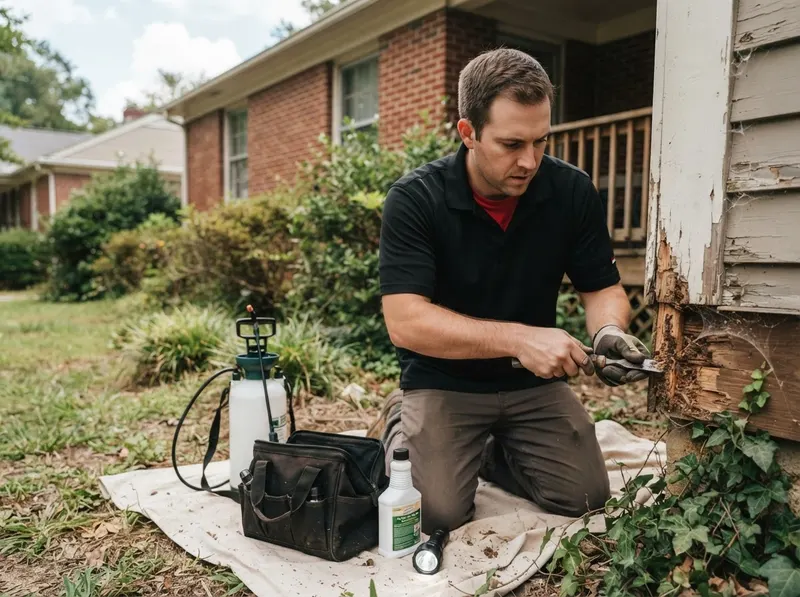
Black carpenter ants (Camponotus pennsylvanicus) do not consume cellulose like termites; instead, worker ants excavate smooth nesting galleries inside softened lumber, weakening the building envelope from within. In humid Midlands environments, structural timbers compromised by roof leaks, plumbing condensation, or elevated crawlspace vapor become prime harborage points. According to Clemson University Cooperative Extension, these colonies establish parent nests in decaying outdoor trees before sending satellite colonies into wall framing. Historic crawlspace foundations in Shandon, Earlewood, and Cottontown frequently experience wood-destroying insect pressure around ground-level subflooring, while slab-on-grade homes throughout Lake Katherine and Forest Acres often see satellite galleries tucked into wet wall assemblies behind dishwashers or under roof valleys near the South Carolina Forestry Commission urban canopy zones.
Effective remediation differs fundamentally from surface sprays, which merely scatter foraging workers while leaving the queen and internal galleries intact. PrairieStone Pest Guard deploys professional active ingredients regulated under the EPA Federal Insecticide, Fungicide, and Rodenticide Act, utilizing targeted micro-injections of non-repellent formulations directly into structural wall cavities. These specialized materials exploit social insect grooming behavior to transfer active lethal chemistry through the satellite population back to the reproductive queen. Structural evaluation protocols adhere to technical guidelines established by the Pest Control Technology guidelines and the National Pest Management Association, ensuring treatment hits harborage sites without causing unnecessary drywall damage.
Long-term structural defense requires pairing colony elimination with rigorous moisture mitigation. Structural dampness accelerates gallery excavation, meaning exterior fungal damage often operates hand-in-hand with insect nesting. Following residential structural integrity standards from the International Code Council, property owners must address perimeter moisture drivers such as blocked crawlspace vents, failed flashing, and leaking gutters. To ensure environmental compliance, treatments follow safety standards outlined by the Occupational Safety and Health Administration and pest management regulations supervised by the South Carolina Department of Agriculture. Direct coordination with building preservation guidance from the South Carolina Department of Health and Environmental Control ensures historic framework in Melrose Heights and Elmwood Park retains its load-bearing capacity.
Technicians systematically identify edge cases, such as hidden nests inside structural foam insulation panels or flat-roof overhangs near Congaree National Park wetland corridors. Where exterior vegetation directly bridges over siding, arboricultural clearance guidelines from the International Society of Arboriculture are applied to eliminate aerial foraging paths. PrairieStone Pest Guard confines remediation to proven, data-supported chemical transfer dynamics, ensuring that once internal structural voids are secured, regional perimeter defenses prevent reinfestation from surrounding deciduous trees.
Every job gets a firm, written price after a free on-site visit.
Tell us about your carpenter ant structural remediation job in columbia and we'll send a clear, written quote, usually the same day.
 PrairieStone Pest Guard