Excessive humidity beneath Midlands residences creates ideal harborage for destructive organisms, requiring decisive defensive protocols rather than temporary surface sprays. Homes built with crawl space foundations…
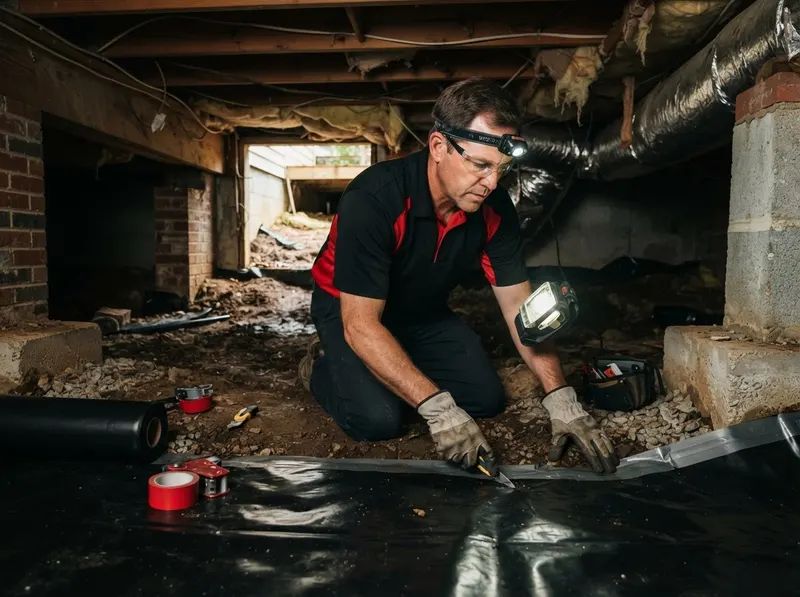
Excessive humidity beneath Midlands residences creates ideal harborage for destructive organisms, requiring decisive defensive protocols rather than temporary surface sprays. Homes built with crawl space foundations across older neighborhoods like Shandon, Rosewood, and Earlewood frequently suffer from ambient relative humidity exceeding 70 percent during South Carolina summers. According to standards published by the Environmental Protection Agency, indoor crawl space humidity should remain below 50 percent to prevent fungal spore germination and structural rot. When ground dampness rises unchecked, native subterranean termites exploit damp sill plates and subfloor joists. Installing continuous Class I vapor retarders compliance-checked against Building Science Corporation guidelines stops moisture migration before subterranean insects can establish colonies inside structural timber framing.
Controlling subfloor humidity directly alters the biological conditions that attract invasive species like smokybrown cockroaches and camel crickets. Ground evaluations conducted near the Congaree River basin and the Columbia Canal and Riverfront Park show that open exterior foundation vents introduce warm, moisture-laden air that condenses against air-conditioned floor systems. Under the mechanical specifications maintained by the American Society of Heating, Refrigerating and Air-Conditioning Engineers, sealing perimeter vents and deploying a dedicated, energy-efficient crawl space dehumidifier stabilizes wood moisture content below 15 percent. This moisture threshold halts active decay fungi and prevents larvae of wood-boring beetles from digesting cellulose. Technicians apply sodium octaborate tetrahydrate directly onto joists in compliance with the Clemson University Department of Pesticide Regulation, creating an enduring barrier against structural pests.
Choosing between simple vapor barrier replacement and complete closed-foundation encapsulation requires evaluating specific site grading and elevation metrics. A standard ground vapor barrier fits properties in elevated sandy areas of Cottontown or Forest Acres that experience moderate seasonal humidity without standing water; this option seals exposed soil while preserving natural perimeter ventilation at a lower project cost. Conversely, full crawl space encapsulation fits low-elevation or poorly drained lots in Elmwood Park and Lake Katherine where standing surface water or chronic humidity threatens hardwood subflooring. While encapsulation requires higher mechanical investment for dedicated condensation drainage conforming to Department of Energy Building Energy Codes, it permanently eliminates the humid microclimate required by wood-destroying insects. The trade-off centers on upfront capital allocation versus ongoing moisture-risk mitigation, as partial barriers leave foundation wall condensation unmanaged during extreme heat waves.
PrairieStone Pest Guard executes barrier defensive measures by applying industrial-grade components designed to withstand crawl space mechanical service traffic. Technicians seal wall perimeters using closed-cell polyurethane foam and mechanical fasteners, leaving a continuous 3-inch inspection gap below framing to maintain visible subterranean termite inspection access as outlined by the National Pest Management Association. Foundation piers in Heathwood, Melrose Heights, and Old Shandon receive tailored wrap-around flashing to stop moisture bridging. To confirm structural stability, workers inspect for prior termite foraging tubes before securing floor membranes, integrating localized chemical barriers when active galleries are discovered under standards supported by the South Carolina Department of Health and Environmental Control, the Occupational Safety and Health Administration, and the National Institute of Standards and Technology. Property owners can establish a perimeter defense evaluation by phoning (803) 887-7915.
Every job gets a firm, written price after a free on-site visit.
Tell us about your crawl space moisture and pest defense job in columbia and we'll send a clear, written quote, usually the same day.
 PrairieStone Pest Guard